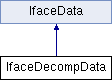
Common data shared by decompiler commands. More...
#include <ifacedecomp.hh>
Public Member Functions | |
| IfaceDecompData (void) | |
| Constructor. | |
| void | allocateCallGraph (void) |
| Allocate the call-graph object. | |
| void | abortFunction (ostream &s) |
| Clear references to current function. More... | |
| void | clearArchitecture (void) |
| Free all resources for the current architecture/program. | |
| void | followFlow (ostream &s, int4 size) |
| Generate raw p-code for the current function. More... | |
| Varnode * | readVarnode (istream &s) |
| Read a varnode from the given stream. More... | |
| void | readSymbol (const string &name, vector< Symbol * > &res) |
| Find a symbol by name. More... | |
 Public Member Functions inherited from IfaceData Public Member Functions inherited from IfaceData | |
| virtual | ~IfaceData (void) |
| Destructor. | |
Public Attributes | |
| Funcdata * | fd |
| Current function active in the console. | |
| Architecture * | conf |
| Current architecture/program active in the console. | |
| CallGraph * | cgraph |
| Call-graph information for the program. | |
| FunctionTestCollection * | testCollection |
| Executable environment from a datatest. | |
Detailed Description
Common data shared by decompiler commands.
Member Function Documentation
◆ abortFunction()
| void IfaceDecompData::abortFunction | ( | ostream & | s | ) |
Clear references to current function.
This is called if a command throws a low-level error. It clears any analysis on the function, sets the current function to null, and issues a warning.
- Parameters
-
s is the stream to write the warning to
References Architecture::clearAnalysis(), conf, fd, and Funcdata::getName().
Referenced by execute().
◆ followFlow()
| void IfaceDecompData::followFlow | ( | ostream & | s, |
| int4 | size | ||
| ) |
Generate raw p-code for the current function.
Follow flow from the entry point of the function and generate the raw p-code ops for all instructions, up to return instructions. If a size in bytes is provided, it bounds the memory region where flow can be followed. Otherwise, a zero size allows unbounded flow tracing.
- Parameters
-
s is a output stream for reporting function details or errors size (if non-zero) is the maximum number of bytes to disassemble
References LowlevelError::explain, fd, Funcdata::followFlow(), Funcdata::getAddress(), AddrSpace::getHighest(), Funcdata::getName(), Address::getSpace(), and Address::printRaw().
Referenced by IfcFuncload::execute(), IfcAddrrangeLoad::execute(), and IfcCallGraphBuild::iterationCallback().
◆ readSymbol()
| void IfaceDecompData::readSymbol | ( | const string & | name, |
| vector< Symbol * > & | res | ||
| ) |
Find a symbol by name.
Find any symbols matching the given name in the current scope. Scope is either the current function scope if a function is active, otherwise the global scope.
- Parameters
-
name is the given name, either absolute or partial res will hold any matching symbols
References conf, fd, Database::getGlobalScope(), Funcdata::getScopeLocal(), Scope::queryByName(), Database::resolveScopeFromSymbolName(), and Architecture::symboltab.
Referenced by IfcRename::execute(), IfcRetype::execute(), and IfcRemove::execute().
◆ readVarnode()
| Varnode * IfaceDecompData::readVarnode | ( | istream & | s | ) |
Read a varnode from the given stream.
The Varnode is selected from the current function. It is specified as a storage location with info about its defining p-code in parantheses.
EAX(r0x10000:0x65)ECX(i)r0x10001000:4(:0x96)u0x00001100:1(:0x102)#0x1(0x10205:0x27)
The storage address space is given as the short-cut character followed by the address offset. For register spaces, the name of the register can be given instead of the offset. After the offset, a size can be specified with a ':' followed by the size in bytes. If size is not provided and there is no register name, a default word size is assigned based on the address space.
The defining p-code op is specified either as:
- An address and sequence number:
EAX(r0x10000:0x65) - Just a sequence number:
EAX(:0x65)or - An "i" token for inputs:
EAX(i)
For a constant Varnode, the storage offset is the actual value of the constant, and the p-code address and sequence number must both be present and specify the p-code op that reads the constant.
- Parameters
-
s is the given input stream
- Returns
- the Varnode object
References Funcdata::beginLoc(), conf, Funcdata::endLoc(), fd, Funcdata::findOp(), Funcdata::findVarnodeInput(), Funcdata::findVarnodeWritten(), PcodeOp::getAddr(), Varnode::getAddr(), Varnode::getDef(), PcodeOp::getIn(), Address::getSpace(), PcodeOp::getTime(), AddrSpace::getType(), IPTR_CONSTANT, Varnode::isFree(), Address::isInvalid(), Varnode::isWritten(), PcodeOp::numInput(), and Architecture::types.
Referenced by IfcPrintVarnode::execute(), IfcVarnodehighCover::execute(), IfcVarnodeCover::execute(), IfcForceFormat::execute(), and IfcAnalyzeRange::execute().
The documentation for this class was generated from the following files:
- ifacedecomp.hh
- ifacedecomp.cc