Associate data-type and behavior information with a specific p-code op-code. More...
#include <typeop.hh>
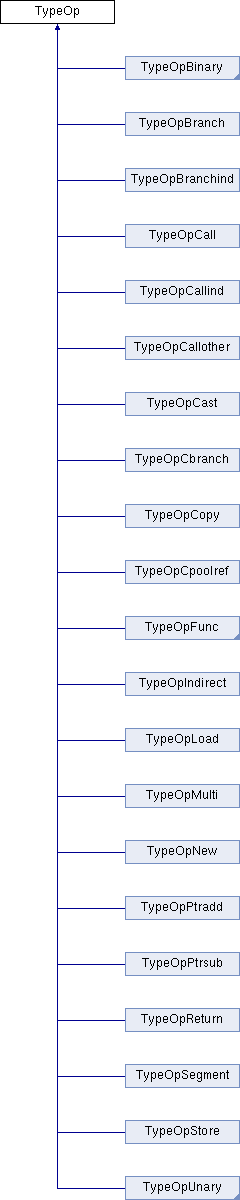
Public Types | |
| enum | { inherits_sign = 1 , inherits_sign_zero = 2 , shift_op = 4 } |
Public Member Functions | |
| TypeOp (TypeFactory *t, OpCode opc, const string &n) | |
| Constructor. More... | |
| virtual | ~TypeOp (void) |
| Destructor. | |
| const string & | getName (void) const |
| Get the display name of the op-code. | |
| OpCode | getOpcode (void) const |
| Get the op-code value. | |
| uint4 | getFlags (void) const |
| Get the properties associated with the op-code. | |
| OpBehavior * | getBehavior (void) const |
| Get the behavior associated with the op-code. | |
| uintb | evaluateUnary (int4 sizeout, int4 sizein, uintb in1) const |
| Emulate the unary op-code on an input value. More... | |
| uintb | evaluateBinary (int4 sizeout, int4 sizein, uintb in1, uintb in2) const |
| Emulate the binary op-code on an input value. More... | |
| uintb | recoverInputBinary (int4 slot, int4 sizeout, uintb out, int4 sizein, uintb in) const |
| Reverse the binary op-code operation, recovering a constant input value. More... | |
| uintb | recoverInputUnary (int4 sizeout, uintb out, int4 sizein) const |
| Reverse the unary op-code operation, recovering a constant input value. More... | |
| bool | isCommutative (void) const |
| Return true if this op-code is commutative. More... | |
| bool | inheritsSign (void) const |
| Return true if the op-code inherits its signedness from its inputs. | |
| bool | inheritsSignFirstParamOnly (void) const |
| Return true if the op-code inherits its signedness from only its first input. | |
| bool | isShiftOp (void) const |
| Return true if the op-code is a shift (INT_LEFT, INT_RIGHT, or INT_SRIGHT) | |
| virtual Datatype * | getOutputLocal (const PcodeOp *op) const |
| Find the minimal (or suggested) data-type of an output to this op-code. More... | |
| virtual Datatype * | getInputLocal (const PcodeOp *op, int4 slot) const |
| Find the minimal (or suggested) data-type of an input to this op-code. More... | |
| virtual Datatype * | getOutputToken (const PcodeOp *op, CastStrategy *castStrategy) const |
| Find the data-type of the output that would be assigned by a compiler. More... | |
| virtual Datatype * | getInputCast (const PcodeOp *op, int4 slot, const CastStrategy *castStrategy) const |
| Find the data-type of the input to a specific PcodeOp. More... | |
| virtual Datatype * | propagateType (Datatype *alttype, PcodeOp *op, Varnode *invn, Varnode *outvn, int4 inslot, int4 outslot) |
| Propagate an incoming data-type across a specific PcodeOp. More... | |
| virtual void | push (PrintLanguage *lng, const PcodeOp *op, const PcodeOp *readOp) const =0 |
| Push the specific PcodeOp to the emitter's RPN stack. More... | |
| virtual void | printRaw (ostream &s, const PcodeOp *op)=0 |
| Print (for debugging purposes) this specific PcodeOp to the stream. More... | |
| virtual string | getOperatorName (const PcodeOp *op) const |
| Get the name of the op-code as it should be displayed in context. More... | |
Static Public Member Functions | |
| static void | registerInstructions (vector< TypeOp * > &inst, TypeFactory *tlst, const Translate *trans) |
| Build a map from op-code value to the TypeOp information objects. More... | |
| static void | selectJavaOperators (vector< TypeOp * > &inst, bool val) |
| Toggle Java specific aspects of the op-code information. More... | |
Protected Member Functions | |
| virtual void | setMetatypeIn (type_metatype val) |
| Set the data-type associated with inputs to this opcode. More... | |
| virtual void | setMetatypeOut (type_metatype val) |
| Set the data-type associated with outputs of this opcode. More... | |
| virtual void | setSymbol (const string &nm) |
| Set the display symbol associated with the op-code. | |
Protected Attributes | |
| TypeFactory * | tlst |
| Pointer to data-type factory. | |
| OpCode | opcode |
| The op-code value. | |
| uint4 | opflags |
| Cached pcode-op properties for this op-code. | |
| uint4 | addlflags |
| Additional properties. | |
| string | name |
| Symbol denoting this operation. | |
| OpBehavior * | behave |
| Object for emulating the behavior of the op-code. | |
Detailed Description
Associate data-type and behavior information with a specific p-code op-code.
This holds all information about a p-code op-code. The main PcodeOp object holds this as a representative of the op-code. The evaluate* methods can be used to let the op-code act on constant input values. The getOutput* and getInput* methods are used to obtain data-type information that is specific to the op-code. This also holds other PcodeOp boolean properties that are set in common for the op-code.
Member Enumeration Documentation
◆ anonymous enum
| anonymous enum |
Constructor & Destructor Documentation
◆ TypeOp()
| TypeOp::TypeOp | ( | TypeFactory * | t, |
| OpCode | opc, | ||
| const string & | n | ||
| ) |
Member Function Documentation
◆ evaluateBinary()
|
inline |
Emulate the binary op-code on an input value.
- Parameters
-
sizeout is the size of the output in bytes sizein is the size of the inputs in bytes in1 is the first input value in2 is the second input value
- Returns
- the output value
References behave, and OpBehavior::evaluateBinary().
Referenced by RuleAddMultCollapse::applyOp(), and PcodeOp::collapse().
◆ evaluateUnary()
|
inline |
Emulate the unary op-code on an input value.
- Parameters
-
sizeout is the size of the output in bytes sizein is the size of the input in bytes in1 is the input value
- Returns
- the output value
References behave, and OpBehavior::evaluateUnary().
Referenced by PcodeOp::collapse().
◆ getInputCast()
|
virtual |
Find the data-type of the input to a specific PcodeOp.
Calculate the actual data-type of the input to the specific PcodeOp. A null result indicates the input data-type is the same as or otherwise doesn't need a cast from the data-type of the actual input Varnode
- Parameters
-
op is the specific PcodeOp slot is the input to consider castStrategy is the current casting strategy
- Returns
- the data-type
Reimplemented in TypeOpCopy, TypeOpLoad, TypeOpStore, TypeOpEqual, TypeOpNotEqual, TypeOpIntSless, TypeOpIntSlessEqual, TypeOpIntLess, TypeOpIntLessEqual, TypeOpIntZext, TypeOpIntSext, TypeOpIntRight, TypeOpIntSright, TypeOpIntDiv, TypeOpIntSdiv, TypeOpIntRem, TypeOpIntSrem, TypeOpPtradd, TypeOpPtrsub, TypeOpSegment, TypeOpCpoolref, and TypeOpNew.
References CastStrategy::castStandard(), Varnode::getHighTypeReadFacing(), PcodeOp::getIn(), PcodeOp::inputTypeLocal(), and Varnode::isAnnotation().
Referenced by ActionSetCasts::castInput(), TypeOpIntRight::getInputCast(), TypeOpIntSright::getInputCast(), TypeOpPtradd::getInputCast(), and TypeOpPtrsub::getInputCast().
◆ getInputLocal()
Find the minimal (or suggested) data-type of an input to this op-code.
The result should depend only on the op-code itself (and the size of the input)
- Parameters
-
op is the PcodeOp being considered slot is the input being considered
- Returns
- the data-type
Reimplemented in TypeOpBinary, TypeOpUnary, TypeOpFunc, TypeOpCbranch, TypeOpCall, TypeOpCallind, TypeOpCallother, TypeOpReturn, TypeOpIntLeft, TypeOpIntRight, TypeOpIntSright, TypeOpIndirect, TypeOpPtradd, TypeOpPtrsub, TypeOpCpoolref, TypeOpInsert, and TypeOpExtract.
References TypeFactory::getBase(), PcodeOp::getIn(), Varnode::getSize(), tlst, and TYPE_UNKNOWN.
Referenced by TypeOpCall::getInputLocal(), TypeOpCallind::getInputLocal(), TypeOpCallother::getInputLocal(), TypeOpReturn::getInputLocal(), TypeOpIndirect::getInputLocal(), and PcodeOp::inputTypeLocal().
◆ getOperatorName()
|
inlinevirtual |
Get the name of the op-code as it should be displayed in context.
Depending on the context, the same op-code may get displayed in different ways.
- Parameters
-
op is the PcodeOp context
- Returns
- the display token
Reimplemented in TypeOpCallother, TypeOpIntZext, TypeOpIntSext, TypeOpIntCarry, TypeOpIntScarry, TypeOpIntSborrow, TypeOpPiece, and TypeOpSubpiece.
References name.
Referenced by TypeOpCallother::getOperatorName(), PrintC::opCallother(), PrintC::opFunc(), TypeOpBinary::printRaw(), TypeOpUnary::printRaw(), TypeOpFunc::printRaw(), TypeOpMulti::printRaw(), TypeOpIndirect::printRaw(), TypeOpSegment::printRaw(), TypeOpCpoolref::printRaw(), and TypeOpNew::printRaw().
◆ getOutputLocal()
Find the minimal (or suggested) data-type of an output to this op-code.
The result should depend only on the op-code itself (and the size of the output)
- Parameters
-
op is the PcodeOp being considered
- Returns
- the data-type
Reimplemented in TypeOpBinary, TypeOpUnary, TypeOpFunc, TypeOpCall, TypeOpCallind, TypeOpCallother, TypeOpPtradd, TypeOpPtrsub, and TypeOpCpoolref.
References TypeFactory::getBase(), PcodeOp::getOut(), Varnode::getSize(), tlst, and TYPE_UNKNOWN.
Referenced by TypeOpCall::getOutputLocal(), TypeOpCallind::getOutputLocal(), TypeOpCallother::getOutputLocal(), TypeOpCpoolref::getOutputLocal(), and PcodeOp::outputTypeLocal().
◆ getOutputToken()
|
virtual |
Find the data-type of the output that would be assigned by a compiler.
Calculate the actual data-type of the output for a specific PcodeOp as would be assigned by a C compiler parsing a grammar containing this op.
- Parameters
-
op is the specific PcodeOp castStrategy is the current casting strategy
- Returns
- the data-type
Reimplemented in TypeOpCopy, TypeOpLoad, TypeOpIntAdd, TypeOpIntSub, TypeOpInt2Comp, TypeOpIntNegate, TypeOpIntXor, TypeOpIntAnd, TypeOpIntOr, TypeOpIntLeft, TypeOpIntRight, TypeOpIntSright, TypeOpIntMult, TypeOpPiece, TypeOpSubpiece, TypeOpPtradd, TypeOpPtrsub, and TypeOpSegment.
References PcodeOp::outputTypeLocal().
Referenced by ActionSetCasts::castOutput(), and TypeOpPtrsub::getOutputToken().
◆ isCommutative()
| bool TypeOp::isCommutative | ( | void | ) | const |
Return true if this op-code is commutative.
- Returns
- true if the ordering of the inputs does not affect the output
References PcodeOp::commutative, and opflags.
◆ printRaw()
|
pure virtual |
Print (for debugging purposes) this specific PcodeOp to the stream.
- Parameters
-
s is the output stream op is the specific PcodeOp to print
Implemented in TypeOpBinary, TypeOpUnary, TypeOpFunc, TypeOpCopy, TypeOpLoad, TypeOpStore, TypeOpBranch, TypeOpCbranch, TypeOpBranchind, TypeOpCall, TypeOpCallind, TypeOpCallother, TypeOpReturn, TypeOpIntSright, TypeOpMulti, TypeOpIndirect, TypeOpCast, TypeOpPtradd, TypeOpPtrsub, TypeOpSegment, TypeOpCpoolref, and TypeOpNew.
Referenced by PcodeOp::printRaw().
◆ propagateType()
|
virtual |
Propagate an incoming data-type across a specific PcodeOp.
The data-type can propagate between any two Varnodes attached to the PcodeOp, either in or out. The pair invn and inslot indicate the Varnode holding the incoming data-type. The pair outvn and outslot indicate the Varnode that will hold the outgoing data-type. The data-type for the outgoing Varnode is returned, which may be different then the incoming data-type as the PcodeOp can transform the data-type as it propagates.
- Parameters
-
alttype is the incoming data-type op is the PcodeOp to propagate across invn is the Varnode holding the incoming data-type outvn is the Varnode that will hold the outgoing data-type inslot indicates how the incoming Varnode is attached to the PcodeOp (-1 indicates output >= indicates input) outslot indicates how the outgoing Varnode is attached to the PcodeOp
- Returns
- the outgoing data-type or null (to indicate no propagation)
Reimplemented in TypeOpCopy, TypeOpLoad, TypeOpStore, TypeOpEqual, TypeOpNotEqual, TypeOpIntSless, TypeOpIntSlessEqual, TypeOpIntLess, TypeOpIntLessEqual, TypeOpIntAdd, TypeOpIntXor, TypeOpIntAnd, TypeOpIntOr, TypeOpMulti, TypeOpIndirect, TypeOpSubpiece, TypeOpPtradd, TypeOpPtrsub, TypeOpSegment, and TypeOpNew.
Referenced by ActionInferTypes::propagateTypeEdge().
◆ push()
|
pure virtual |
Push the specific PcodeOp to the emitter's RPN stack.
Given a specific language and PcodeOp, emit the expression rooted at the operation.
- Parameters
-
lng is the PrintLanguage to emit op is the specific PcodeOp readOp is the PcodeOp consuming the output (or null)
Implemented in TypeOpCopy, TypeOpLoad, TypeOpStore, TypeOpBranch, TypeOpCbranch, TypeOpBranchind, TypeOpCall, TypeOpCallind, TypeOpCallother, TypeOpReturn, TypeOpEqual, TypeOpNotEqual, TypeOpIntSless, TypeOpIntSlessEqual, TypeOpIntLess, TypeOpIntLessEqual, TypeOpIntZext, TypeOpIntSext, TypeOpIntAdd, TypeOpIntSub, TypeOpIntCarry, TypeOpIntScarry, TypeOpIntSborrow, TypeOpInt2Comp, TypeOpIntNegate, TypeOpIntXor, TypeOpIntAnd, TypeOpIntOr, TypeOpIntLeft, TypeOpIntRight, TypeOpIntSright, TypeOpIntMult, TypeOpIntDiv, TypeOpIntSdiv, TypeOpIntRem, TypeOpIntSrem, TypeOpBoolNegate, TypeOpBoolXor, TypeOpBoolAnd, TypeOpBoolOr, TypeOpFloatEqual, TypeOpFloatNotEqual, TypeOpFloatLess, TypeOpFloatLessEqual, TypeOpFloatNan, TypeOpFloatAdd, TypeOpFloatDiv, TypeOpFloatMult, TypeOpFloatSub, TypeOpFloatNeg, TypeOpFloatAbs, TypeOpFloatSqrt, TypeOpFloatInt2Float, TypeOpFloatFloat2Float, TypeOpFloatTrunc, TypeOpFloatCeil, TypeOpFloatFloor, TypeOpFloatRound, TypeOpMulti, TypeOpIndirect, TypeOpPiece, TypeOpSubpiece, TypeOpCast, TypeOpPtradd, TypeOpPtrsub, TypeOpSegment, TypeOpCpoolref, TypeOpNew, TypeOpInsert, TypeOpExtract, and TypeOpPopcount.
Referenced by PrintC::emitExpression(), PrintC::pushImpliedField(), and PrintLanguage::recurse().
◆ recoverInputBinary()
|
inline |
Reverse the binary op-code operation, recovering a constant input value.
If the output value and one of the input values is known, recover the value of the other input.
- Parameters
-
slot is the input slot to recover sizeout is the size of the output in bytes out is the output value sizein is the size of the inputs in bytes in is the known input value
- Returns
- the input value corresponding to the slot
References behave, and OpBehavior::recoverInputBinary().
Referenced by JumpBasic::backup2Switch().
◆ recoverInputUnary()
|
inline |
Reverse the unary op-code operation, recovering a constant input value.
If the output value is known, recover the input value.
- Parameters
-
sizeout is the size of the output in bytes out is the output value sizein is the size of the input in bytes
- Returns
- the input value
References behave, and OpBehavior::recoverInputUnary().
Referenced by JumpBasic::backup2Switch().
◆ registerInstructions()
|
static |
Build a map from op-code value to the TypeOp information objects.
- Parameters
-
inst will hold the array of TypeOp objects, indexed on op-code tlst is the corresponding TypeFactory for the Architecture trans is the Translate object for floating-point formats
References CPUI_BOOL_AND, CPUI_BOOL_NEGATE, CPUI_BOOL_OR, CPUI_BOOL_XOR, CPUI_BRANCH, CPUI_BRANCHIND, CPUI_CALL, CPUI_CALLIND, CPUI_CALLOTHER, CPUI_CAST, CPUI_CBRANCH, CPUI_COPY, CPUI_CPOOLREF, CPUI_EXTRACT, CPUI_FLOAT_ABS, CPUI_FLOAT_ADD, CPUI_FLOAT_CEIL, CPUI_FLOAT_DIV, CPUI_FLOAT_EQUAL, CPUI_FLOAT_FLOAT2FLOAT, CPUI_FLOAT_FLOOR, CPUI_FLOAT_INT2FLOAT, CPUI_FLOAT_LESS, CPUI_FLOAT_LESSEQUAL, CPUI_FLOAT_MULT, CPUI_FLOAT_NAN, CPUI_FLOAT_NEG, CPUI_FLOAT_NOTEQUAL, CPUI_FLOAT_ROUND, CPUI_FLOAT_SQRT, CPUI_FLOAT_SUB, CPUI_FLOAT_TRUNC, CPUI_INDIRECT, CPUI_INSERT, CPUI_INT_2COMP, CPUI_INT_ADD, CPUI_INT_AND, CPUI_INT_CARRY, CPUI_INT_DIV, CPUI_INT_EQUAL, CPUI_INT_LEFT, CPUI_INT_LESS, CPUI_INT_LESSEQUAL, CPUI_INT_MULT, CPUI_INT_NEGATE, CPUI_INT_NOTEQUAL, CPUI_INT_OR, CPUI_INT_REM, CPUI_INT_RIGHT, CPUI_INT_SBORROW, CPUI_INT_SCARRY, CPUI_INT_SDIV, CPUI_INT_SEXT, CPUI_INT_SLESS, CPUI_INT_SLESSEQUAL, CPUI_INT_SREM, CPUI_INT_SRIGHT, CPUI_INT_SUB, CPUI_INT_XOR, CPUI_INT_ZEXT, CPUI_LOAD, CPUI_MAX, CPUI_MULTIEQUAL, CPUI_NEW, CPUI_PIECE, CPUI_POPCOUNT, CPUI_PTRADD, CPUI_PTRSUB, CPUI_RETURN, CPUI_SEGMENTOP, CPUI_STORE, CPUI_SUBPIECE, and tlst.
Referenced by Architecture::buildInstructions().
◆ selectJavaOperators()
|
static |
Toggle Java specific aspects of the op-code information.
Change basic data-type info (signed vs unsigned) and operator names ( '>>' vs '>>>' ) depending on the specific language.
- Parameters
-
inst is the array of TypeOp information objects val is set to true for Java operators, false for C operators
References CPUI_INT_AND, CPUI_INT_NEGATE, CPUI_INT_OR, CPUI_INT_RIGHT, CPUI_INT_XOR, CPUI_INT_ZEXT, TYPE_INT, TYPE_UINT, and TYPE_UNKNOWN.
Referenced by PrintC::adjustTypeOperators(), and PrintJava::adjustTypeOperators().
◆ setMetatypeIn()
|
inlineprotectedvirtual |
Set the data-type associated with inputs to this opcode.
Reimplemented in TypeOpBinary, TypeOpUnary, and TypeOpFunc.
◆ setMetatypeOut()
|
inlineprotectedvirtual |
Set the data-type associated with outputs of this opcode.
Reimplemented in TypeOpBinary, TypeOpUnary, and TypeOpFunc.
The documentation for this class was generated from the following files:
- typeop.hh
- typeop.cc